


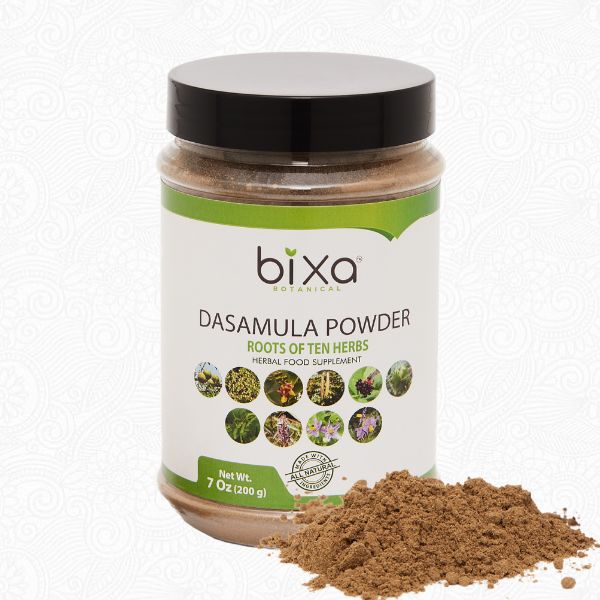



Dasa Moola is a traditional Ayurvedic herbal blend used in India primarily for its Vata (air) and Kapha (water) balancing properties. A unique blend of ten different roots, each carefully selected for their own specific health benefits. The word ‘Dashmool’ derives from two Sanskrit words ‘Dash‘, meaning ten, and ‘Moola‘, meaning root.
In traditional ayurvedic medicine, it is used to treat inflammation, pain, respiratory problems and fatigue. It is used to support detoxification of the body, and to relieve constipation and bloating. This herbal blend helps to improves bowel mobility and to eliminate undigested food waste (ama). It has a grounding effect, helping the downward flow of Vata (air) energy.
What is Dasa Moola ?
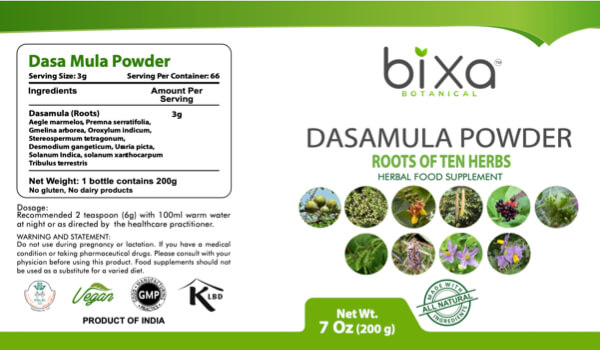
Components of Dasa moola, Dashmool, or Dasamula herbal mix:
Bilva, Agnimantha, Shyonaka, Patala, Gambhari, Brihati, Kantakari, Gokshura, Shalaparni, Prishniparni
Botanical names:
Aegle marmelos, Premna integrifolia, Oroxylum indicum, Stereospermum suaveolens, Gmelina arborea, Solanum indicum, Solanum xanthocarpum, Tribulus terrestris, Desmodium gangeticum, Uraria picta
General effects of Dasa Moola based on Ayurvedic observations:
- Vata balancing herbal remedy
- Grounding
- Anti-inflammatory and analgesic
- Natural calming effect on the nerves
- Natural expectorant
- Improves bowel motility
- Digestive aid (bloating, constipation)
- Roborating and strengthening effect
- No direct effect on thyroid function
In more detail by component:
Bael also known as Bilva (Aegle marmelos): digestive, detoxifying, anti-inflammatory. Pacifies both Vata and Kapha doshas, it is a natural expectorant. Rasa (taste): astringent, bitter
Clove tree, also known as Agnimantha (Premna serratifola): known for its analgesic and anti-inflammatory properties, used for example in the treatment of rheumatic complaints. A nerve tonic that helps to pacify Vata and Pitta dosha, has a cooling effect. Rasa (taste): bitter
Ash tree, also known as Gambhari (Gmelina arborea): used for its analgesic and anti-inflammatory effects, for example in the treatment of rheumatic problems. Also beneficial for treating respiratory problems such as asthma and cough. Helps the downward flow of vata (air) energy in the body. Rasa (taste): bitter and astringent
Indian willow bark, also known as Shyonak (Oroxylum indicum): used to alleviate respiratory problems such as coughs or asthma. Anti-inflammatory. Helps to improve urine excretion and thus supports healthy kidney function. Pacifies pitta and kapha dosa, natural expectorant. Helps the flow of vata (air) energy downward through the body. Rasa (taste): bitter, astringent
Sandalwood, also known as Patala (Stereospermum suaveolens): has anti-inflammatory and antimicrobial properties (used against infections). Supports healthy liver function. It is a calming herb, beneficial for treating stress or anxiety. Pacifies pitta dosha. Rasa (taste): sweet, bitter
Shalaparni (Desmodium gangeticum): known for its anti-inflammatory and analgesic properties. It has a calming effect and is beneficial for treating stress or anxiety. Pacifies vata dosha. Rasa (taste): sweet, bitter
Prishniparni, Prushniparni (Uraria picta): used for its analgesic and anti-inflammatory properties to help alleviate rheumatic pain and inflammation. It can also help in the treatment of respiratory problems such as asthma or cough. Tridosha, helps to balance all three doshas. Rasa (taste): sweet, bitter
African aubergine, also known as Brihati, Bruhati (Solanum indicum): renowned for its respiratory and digestive properties. Traditionally used to treat respiratory problems such as asthma or cough. In ayurveda it also helps to relieve digestive problems such as bloating or stomach pain. Anti-inflammatory. Pacifies vata and kapha dosha. Rasa (taste): sweet, bitter
Thai aubergine, also known as Kantakari (Solanum xanthocarpum): it has both antibacterial and antimicrobial effects, and helps fight infections. It is used for its respiratory and anti-inflammatory properties to treat respiratory problems such as asthma or cough. Rasa (taste): bitter, sweet
Gokshura (Tribulus terrestris): in Ayurveda used to support healthy kidney function and urine production. Has diuretic and anti-inflammatory effects. Known as an aphrodisiac, which may help support sexual health and performance. Rasa (taste): sweet, bitter
It is beneficial in the treatment of the following symptoms / diseases
- Arthritis (Arthritis)
- Treatment of rheumatic complaints
- Asthma
- Treatment of respiratory problems, cough relief
- Parkinson’s disease
- Gout
- Muscle spasm, back pain
- Treating stress or nervous system problems (vata pacifier)
- Bloating, stomach pain
- General weakness
Energetic effects based on Ayurvedic observations
- Rasa – Taste: astringent, sweet
- Vipaka – Post digestive effect: pungent
- Virya – Heat effect: heating
- Dosha impact: pacifies vata and kapha dosha
Product quality guarantee:
Our supplier partner in India is a certified organic producer of Ayurvedic products. All our products are 100% vegan, with cellulose capsules and Halal and Kosher certified.










Scientific research and publications on Dasa mula
There are a number of scientific studies on the use and benefits of Dasa mula. Studies explore, among other things, its effects on reducing inflammation and pain. Some of these articles (available in English, as they are international publications):
- “Experimental evaluation of analgesic, anti-inflammatory and anti-platelet potential of Dashamoola” 2015, PubMed central
- “DASHAMOOLA: A SYSTEMATIC OVERVIEW” 2022, May, Researchgate
- “A review on Dashamoola”, 2022, Jetir



 and Kapha …</p>
)
Reviews
There are no reviews yet